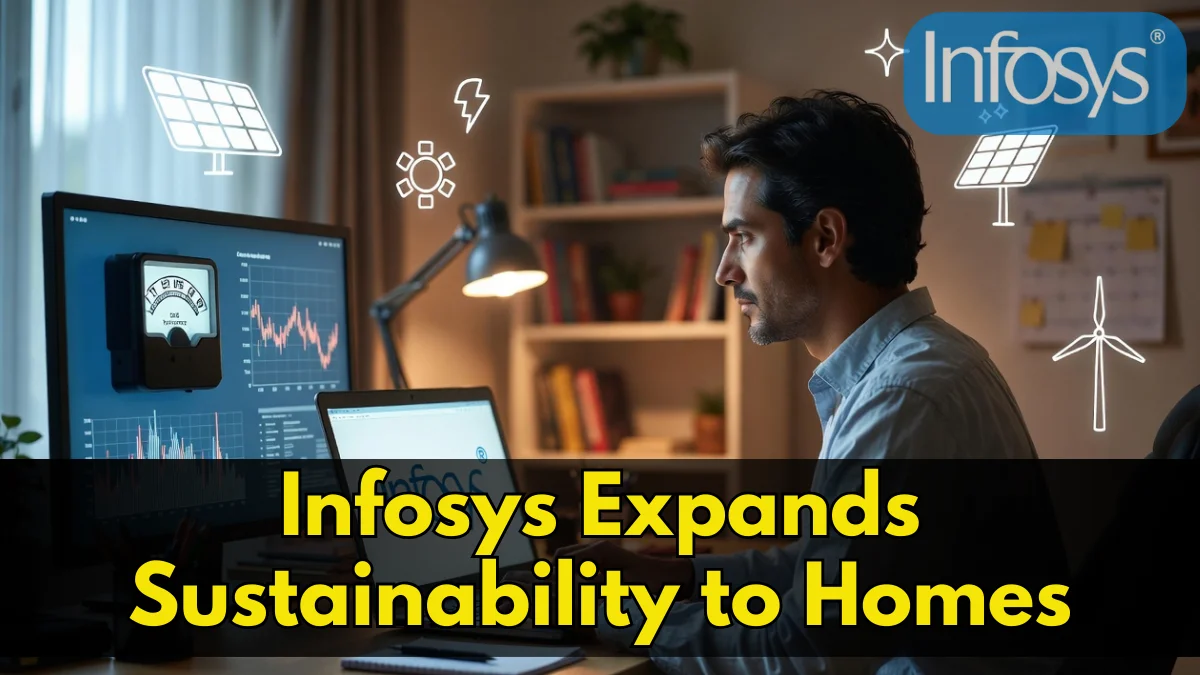
Most people assume sustainability reporting focuses on office buildings, data centers and company infrastructure. However, Company is taking a more detailed route. The company recently started asking employees who work from home to share general information about their household electricity consumption. This step shows how seriously Infosys treats its environmental commitments and how corporate sustainability practices are changing because of hybrid work.
Why Infosys Wants This Information
Company follows strict sustainability goals. The company aims for accurate reporting, so it now studies energy use linked to remote work too. Many employees work from home several days a month. The electricity they use for laptops, lights, fans, air conditioners and routers contributes to the company’s indirect emissions.
Infosys wants to understand this energy use instead of relying on rough estimates. That helps the company measure its real environmental footprint.
What Infosys Asks Employees to Share
The survey focuses on broad patterns, not individual tracking. Employees can voluntarily share details such as:
- Approximate monthly electricity usage
- Appliances used during work hours
- Energy saving habits
- Use of solar power at home
Infosys uses the combined data to understand average power consumption during remote work. The goal is to improve the accuracy of sustainability reporting without affecting employee privacy.
How This Helps Sustainability Reporting
Global ESG standards expect companies to disclose emissions linked to work activities. Office emissions are easy to measure. Home emissions are not. Because hybrid work is now permanent, companies must adjust their reporting methods.
Infosys wants to create a clear picture of total emissions. This approach supports its climate goals and improves the quality of its ESG disclosures.
Privacy Concerns and Assurances
Employees raised questions about data privacy. Company responded by explaining the process clearly. Participation is voluntary. The company collects only broad, non-sensitive details. It then converts the responses into anonymous data sets. No one reviews personal household information. The company only studies combined energy patterns.
This approach protects privacy while still helping Infosys understand remote work emissions.
Hybrid Work Has Changed How Energy Gets Used
Hybrid work spreads energy use across thousands of homes instead of a single campus. Office buildings usually have efficient air conditioning, centralized lighting and monitored energy systems. Homes differ in size, climate, appliances and efficiency.
Because work now happens in many environments, companies must update how they calculate emissions. Infosys is moving in that direction by including remote work energy in its sustainability strategy.
Why Companies Everywhere Are Watching This Move
Infosys is one of the first major Indian IT firms to ask for electricity usage data from employees working in hybrid mode. Other companies may follow because:
- Investors demand stronger ESG performance
- Clients prefer partners with transparent environmental practices
- Regulators push companies to disclose detailed emissions
- Remote work has become permanent
If Infosys succeeds in building better ESG reports through this method, other technology companies may adopt it too.
Simple Key Points
- Infosys is collecting home electricity data from hybrid workers
- The company wants accurate sustainability reporting
- Participation is voluntary
- Employee privacy stays protected through anonymized data
- Hybrid work changes how energy gets consumed
- Global ESG standards require better emissions tracking
- Infosys aims to strengthen its climate commitments
Infosys Official Website
Infosys ESG Vision 2030 (Official Infosys sustainability page)
Conclusion
Company has expanded the way it measures environmental impact by studying electricity use during remote work. This approach reflects the new reality of hybrid work and the rising importance of transparent ESG reporting. The company wants better data, stronger climate planning and more reliable disclosure. When handled responsibly, this initiative can improve sustainability reporting without hurting employee privacy or comfort.
For More Information Click HERE